All our blogs for our second season are listed below. Thanks for reading!

Presenting … MUSIC FOR YOU!
Muusic 4UU Season Two: Spring
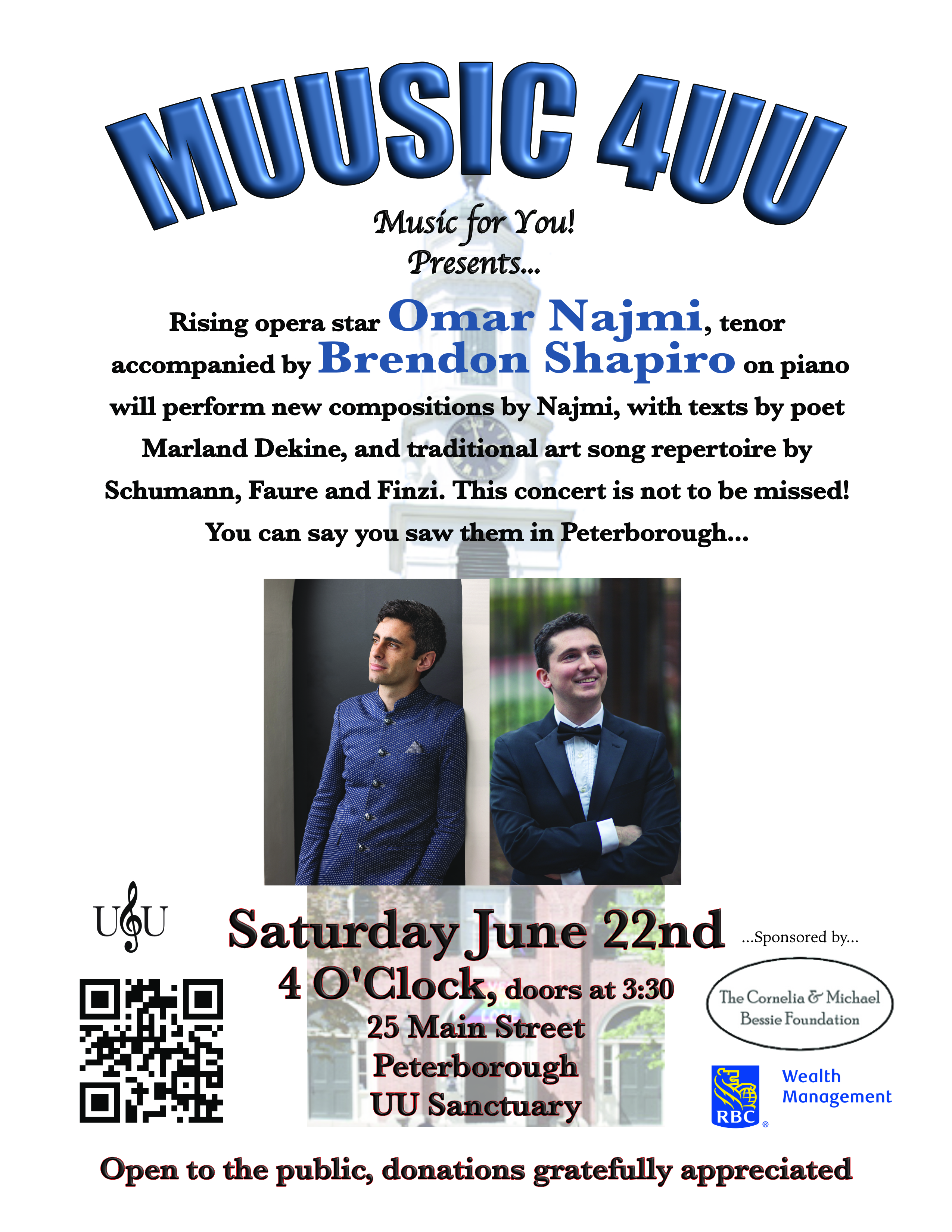
A Concert of Art Song and Lieder by Omar Najmi, tenor.
With Brendon Shapiro, piano
Transformations
Selections from A Young Man’s Exhortation – music by Gerald Finzi, text by Thomas Hardy
I. A Young Man’s Exhortation
II. Ditty
IX. Transformations
X. The Dance Continued
Four Songs – music by Gabriel Fauré
Spleen – text by Paul Verlaine
Tristesse – text by Théophile Gautier
Toujours – text by Charles Grandmougin
En Sourdine – text by Paul Verlaine
-Intermission-
Selections from Lieder und Gesänge aus Wilhelm Meister – music by Robert Schumann, text by Johann Wolfgang von Goethe
I. Kennst du das Land
III. Nur wer die Sehnsucht kennt
V. Heiss’ mich nicht reden
IX. So lasst mich scheinen
More Than Our Own Caves (in five movements)- music by Omar Najmi, text by Marlanda Dekine
***
Program Notes
An idea not considered often enough is that the job of each new generation of artists is to pay it forward. The extent to which we all stand on the shoulders of those who came before us is most particularly true of all the practitioners of the arts, but we frequently lose sight of a peculiar American character flaw: our strong tendency to value an inflexible and maverick nature and an even stronger drive to tragically downplay our own creative spirit as we worship the Sacred Cows of Eurocentric Arts. This does no justice to our culture or its furtherance; all the while our creative Id is being trampled by our capitalist Ego.
This is why, I think, we find new artists like Omar Najmi and Brendon Shapiro not just refreshing, but we cling to them as we would to a lifeline. It’s not just that they are young — to me looking back on my 40 year career they are children. Nor it is that they are talented — wouldn’t we just die for that wonderful outpouring of energy and ideas? Not just that they have done it — how many good ideas have we oldsters let languish? It is that they have grasped our tired old shibboleths and given them a good shake, way, way past time for that to have happened.
Brendon and Omar are co-founders of Catalyst New Music, an organization dedicated to the commissioning, development, and performance of new musical works. Here in Omar’s words is what they’re up to:
We started Catalyst because we felt that there was a gap between the creators of new music and their potential audience. Some folks avoid ‘new music’ because they assume that it will be inaccessible, too experimental, or that they simply won’t like it – when the truth is we hear and love new music all the time in movie soundtracks, video games, and more. Our dream is to bridge the gap by creating new musical experiences that appeal to audiences that are completely new to modern classical music as well as to long-time lovers of the genre. Every time we put on a performance, even a recital like this one, we’ll sprinkle in some new music just to give our audiences the chance to realize that they may love modern music far more than they knew!
Past Catalyst projects have included the world-premiere of Omar’s opera En la ardiente oscuridad, the concert premiere of Omar’s opera This Is Not That Dawn, and an annual song commission project called FUSE: Collaborations in Song, co-produced with Boston Singers’ Resource. In the next season, Catalyst looks forward to presenting the world-premiere of Zal & the Phoenix, a musical fairy tale by Persian composer Shohreh Shakoory.
Links to excerpts of past Catalyst performances:
For more information visit www.catalystnewmusic.com
***
Bios and Highlights
Boston-based artist Omar Najmi splits his time between composition and performance, maintaining a busy schedule as an operatic tenor. In the upcoming season, he will debut with Boston Baroque in Handel’s Messiah, with Los Angeles Opera as Simon in Adoration, and as a composer for Washington National Opera. Najmi enjoys a long standing relationship with Boston Lyric Opera where he began his professional career as an Emerging Artist (2013-2015). His other operatic engagements have included Opera Colorado, Chautauqua Opera, Opera Steamboat, Opera Fayetteville, Annapolis Opera and many others. He has performed at Carnegie Hall twice.
Najmi began his composition career with the production of his first opera, En la ardiente oscuridad in 2019. After a run of sold-out performances, he was invited to serve as the first-ever Emerging Composer in residence with Boston Lyric Opera, where he worked with Boston Youth Poet Laureate Alondra Bobadilla in the creation of the song cycle my name is Alondra. His second opera, This Is Not That Dawn was premiered in concert by Catalyst New Music in 2022 and his song cycle More Than Our Own Caves received its premiere with Juventas New Music Ensemble in 2023.
I asked him for the highlights of his career and he named:
- Creating the title role in Joseph Summer’s Hamlet with Bulgaria’s State Opera Rousse
- Creating the role of Simon in Mary Kouyoumdjian and Royce Vavrek’s Adoration with Beth Morrison Projects and Los Angeles Opera
- Over 15 roles with Boston Lyric Opera, including recent appearances as Valcour in The Anonymous Lover
- Tenor Soloist in Bach Cantata BWV 94 at Bachfest Leipzig
- Tenor Soloist in Mark Hayes’ Gloria and Dan Forrest’s Requiem for the Living at Carnegie Hall
- Composer for Washington National Opera’s American Opera Initiative, where Omar’s and Christine Evans’ opera Mud Girl will receive its premiere in 2025
***
Pianist, vocal coach and conductor, Brendon Shapiro is a champion of vocal music of the 20th and 21st centuries. He is passionate about the way music can help to shine a light on stories and perspectives that have not historically been represented on American stages and he specializes in working closely with singers and composers to create performances that will communicate effectively with diverse audiences. Brendon is a regular member of the music staff at Boston Lyric Opera where he was an Emerging Artist pianist from 2018 to 2020, serving as coach and pianist on many operas. He is also an alumnus of Los Angeles Opera’s Young Artist Program where he worked with such artists as Renee Fleming and Susan Graham.
As a conductor and music director, Brendon helps being new works to life at Catalyst New Music, a company he co-founded with his husband, Omar Najmi in 2022. Together they have workshopped Mr. Najmi’s operas and started an art song development program called FUSE: Collaborations in Song. Brendon has also conducted at Opera Fayetteville, Boston Opera Collaborative, MASSOpera and has served as Assistant Conductor at Boston Conservatory at Berklee.
He also has a fundamental role at Boston Singers’ Resource, a non-profit organization dedicated to providing classical singers with the tools to pursue their careers, developing new programs designed to provide more opportunities for emerging singers in the New England area. He has also been a faculty vocal coach at Boston Conservatory at Berklee, University of Massachusetts, Amherst, and Boston University Tanglewood Institute.
Mr. Shapiro considers to be some highlights of his career thus far:
- Principal rehearsal pianist for the world-premiere of Matthew Aucoin and Sarah Ruhl’s Eurydice at LA Opera
- Pianist, vocal coach, and music staff at Boston Lyric Opera
- Collaborating with opera star Susan Graham in recital
- Principal rehearsal pianist for Rhiannon Giddens and Michael Abels’ Omar at San Francisco Opera, Los Angeles Opera, and Boston Lyric Opera
- Executive Director of Boston Singers’ Resource
- Conductor at Boston Conservatory, Opera Fayetteville, and Catalyst New Music
***
Welcome to the Muusic 4UU Blogsite! We’re starting the second half of Season Two and we’re so excited about our success of our fall 2023 offerings. It’s always so great to see something that has been created take flight, but the real success is in the followers and supporters that get on board with us, the creative team.
Soooo, if you are reading this, you are either one of those supporters, or you just got here because you found the QR code on one of our posters or postcards and scanned it. If you are in the former camp:
THANK YOU!!!
If you’re a newcomer to Muusic 4UU: WELCOME!
Here you will find all the information you need to know (or ever hope to!) about all our performances that we present throughout a season. We will add all the program and performer information for each concert as it comes up, so you may have to scroll down a bit to find the one you are currently attending. But just think, almost no paper waste, low printing costs, and information that can be archived and still available for all time … we’re green, baby!
WHO ARE WE?
We are all members of the group of musicians who live and work in the Peterborough, NH area; some of whom attend the Peterborough Unitarian Universalist Church (hence the proliferation of UU in our logo!). Coming out of the pandemic and seeing an opportunity to bring back live music, we’re starting a series of concerts to help bring more music and joy into the world. Our performers are professionals — local and regional and our groove is uh, shall we say diverse? From folk and jazz, to blues and country, to classical and opera — our plan is to keep it interesting and representative of who we are in our musical souls up here in Peterborough, New Hampshire.
Muusic 4UU is sponsored by The Bessie Foundation and RBC Wealth Management.
***
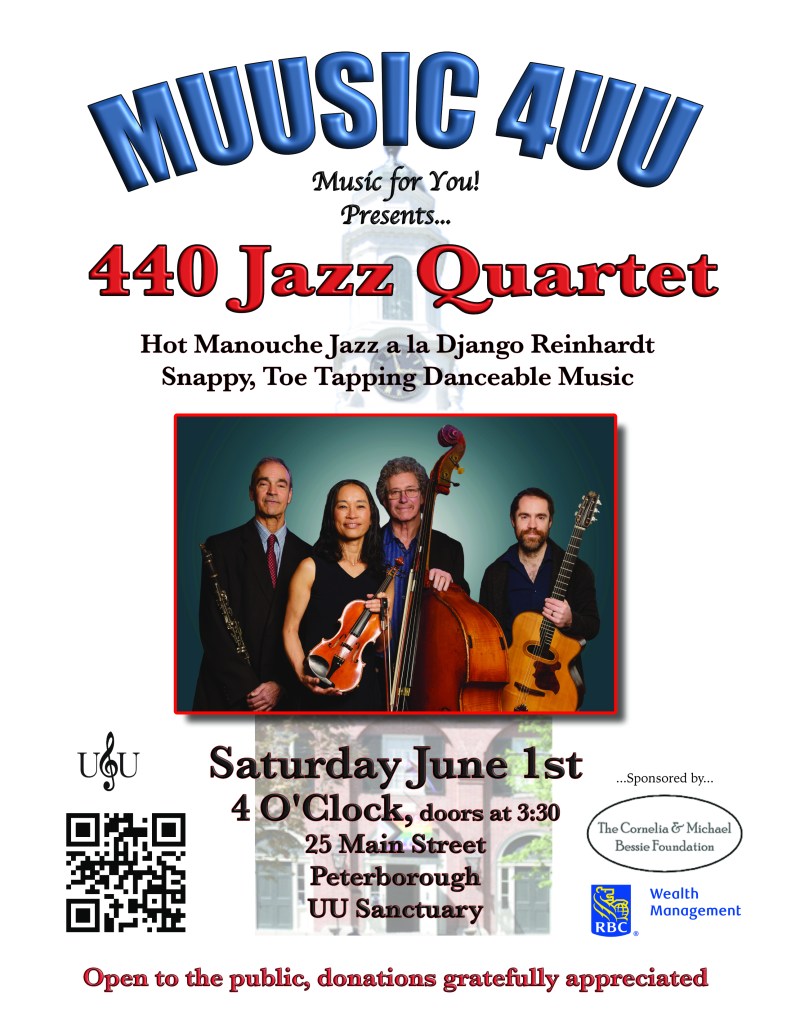
440 Jazz Quartet – a deep dive into tradition and culture.
Because 440 Jazz Quartet specializes in Manouche jazz, I wanted to start by
speaking half-way intelligently about what “Manouche” jazz is and what it means. Not wanting to commit any egregious malapropisms, I began a
journey through Wikipedia and so want to share some of that information with you. After all, the term “manouche” is not in wide use around these
parts.
Manouche is a Romani word meaning “man” or “human” – it’s a generic term for a subset of the many Roma populations around the world. In this case it is
specifically centered around a group of Romani people who settled in France probably in the 18th century. FYI, the history of the Roma people – that group of wanderers who perhaps define the concept of diaspora — is a very interesting one. True, not exactly in the purview of this blog except where it intersects with French Jazz, but it was an eye opener for me to learn that the origins of this group began on the Indian subcontinent, both genetically and linguistically. According to Wikipedia they were a caste of traveling musicians and dancers, and they migrated into Europe sometime in the 13th century.
So, Manouche jazz is Franco/Romani Jazz and as such the term is an accurate
and considerably more dignified term than the original term “gypsy” which is
now considered pejorative by most.
Tomoko Iwamoto is clearly not herself Roma but doesn’t stop her being an
amazing jazz violinist. Hailing originally from Osaka, Japan, she moved to this country to attend Berklee College of Music in 1989, earning her degree in Jazz Composition in 1993. As she says herself, she was familiar with the Stephane Grappelli / Django Reinhardt style of jazz while at school, but was more interested in developing her own jazz string quartet sound in earlier groups such as the J-Way (a Fast and Curvy Quartet), named after the fast and curvy Jamaica Way in Boston, aka the narrowest four-lane highway in the Commonwealth.
Later, as her own sound grew and developed, her interest was awakened in the works of Stephane Grappelli, the jazz violinist who collaborated with Reinhardt in creating the seminal body of French jazz standards and originals from 1934 to 1951. Iwamoto’s current artistic inclinations grew out of her collaboration with her guitarist, Jack Soref in forming a string-based quartet similar to the original Reinhardt / Grappelli Quintette du Hot Club de France.
When the six-fingered guitar virtuoso Django Reinhardt, discovered American jazz, he was already well established as traveling guitarist in France. He was the product of his artistic parents, both of Manouche Romani descent, and he began playing the guitar at an early age. He was introduced to recordings of Joe Venuti, violinist, and Eddie Lang, guitar, both members of the Paul Whiteman Orchestra, as well as many other seminal American jazzers like Louis Armstrong.
That exposure was life-altering and when he met Stephane Grappelli in 1931 their collaborative works and recordings changed the sound of jazz forever. Grappelli had been raised mostly in orphanages – his mother had died early in his life and his father was a military man conscripted into WWI. Grappelli picked up the violin at age 12 and began busking on the streets of Paris and soon was thus picked up off those streets and into his professional career.
The friendship between the two men was as much creative foment as it was a
working relationship, and the sound they created is considered among the best: in an instant improvisational jazz went from being a popular black American music to being understood a Music of the World. To this day, tunes like Nuages and Minor Swing are standards in the Traditional Jazz repertoire.
We are incredibly fortunate to be able to enjoy players with the facility to
perform this amazing but complicated jazz! However, Iwamoto is also an
accomplished composer with many wonderful creations to her credit. In her own words: “I listen to many varieties of jazz from different eras – from early
jazz to swing to bebop and Latin jazz; also world music and classical
music. I write based on whatever I’m inspired by at the moment.” Having assembled a world-class group of musicians: John Clark on clarinet, Jack Soref on guitar and Josiah Reibstein on bass – Iwamoto lets me know that it is the interplay of the musicians that creates both the spontaneous sound and infectious excitement.
This is a show you don’t want to miss!
***

Visit our website at muusic4uu.org
Maple TreeO — sturdy as an oak, twisted as a bonsai
Maple TreeO, that music group that has a name based on a tree based on a type of ensemble, based on a silly pun, has been around for awhile, but we’re not sure that folks ‘round these parts know that much about them. So, I decided to chase them all down – not an easy task, I assure you – to get them to talk about themselves. We met at the Home Town Diner in Rindge over Eggs Benedict and Coffee and it quickly disintegrated into non-sequiturs, jokes, puns, witticisms, paronomasia, and calembour (ok, I went to the Thesaurus).
Here below is our conversation, edited for decency. In full disclosure, we are all on the Board of Directors for Muusic 4UU, the name itself a pun.
Lucinda How did you get that name? I think David had something to do with it.
Eric Blackmer I think David had something to do with it. Though I doubt if the original name came from him, but the Trio probably did. Right.
Joy Flemming It was fall time. Or spring time. Might have been spring time.
Eric We went out and took a picture near your maple tree. That was after we had the meeting.
David Flemming And I’ve been seeing the leaves fall off the maple trees. So they were in my mind.
Eric But this is clearly maple country. So I think that’s probably why.
Lucinda I’m thinking David probably said, Maple Tree. Oh.
Eric Like that. That’s the kind of thing.
Joy And then we had endless discussions whether it should be Trio. Or Tree-OH. Or many other iterations of Trio.
Eric I was very happy because I have a terrible sense of humor, just like David does. And that we would agree to do something as bizarre as this. I like that. That’s funny.
David Yeah. You see, he’s just as bad as I am.
Lucinda Well, David never can. David has no restraint.
Eric It’s a constant with David.
Eric We all met because we were living in town. Our kids were friends.
Joy But we didn’t start playing music together until very recently.
Eric It started out where David needed to be playing some Irish tunes. After a while it started getting pretty good and Joy was sitting at the sidelines saying this is fun. I wasn’t aware of that but suddenly all three of us were playing and it just clicked.
Lucinda Something along the lines of serendipity.
Eric It was very serendipitous. It’s not exactly what you’d call marriage is the wrong word. There’s a better word for it. Melding?
Lucinda Synchronicity.
Joy Eric is pretty much very trained. You went to Berkeley for all those years.
Eric I never went to Berkeley.
JoyI always thought you did.
Eric I went to UMass. UMass Boston where I learned how to juggle.
David He’s a bloody genius.
Eric I have good microphones.
Joy We used to do the Parish Hall open stage at the Unitarian at the PUUC. Eric was the sound guy and he would almost always play a set. Then we would play something classical. Then Eric and David started jamming together on Irish music. David plays both sides – he plays classical music but he’s always known how to jam and play jazz.
David I’m a non-binary flautist.
Joy Then you started teaching me how to get off the paper. A friend of ours, Allison, said that I was paper trained.
Lucinda A good thing for a bassoonist.
Joy The summary is Eric’s more of a rhythm guitar player, chord charts, playing by ear, singer-songwriter. David is classically trained but also can jam. Then I came kind of late to jamming and David taught me how to jam by saying pick a nursery tune like Old McDonald and play it on all the keys. Then when we came together, then I started playing bass line. So this is the first time that I’ve started playing bass line, just from the chords.
Eric David often starts out playing the melody on the flute I’m sort of plunking along doing supportive chords. Joy’s doing everything else. Running bass and doing little flourishes and counter melodies, doing the harmonies. So in terms of the jamming mentality. You probably do it best because you really do.
Joy Truth be told, David sometimes takes liberties with the tempo within the measure.
David I’m not sure whether it’s liberties or lack of control.
Eric But every time it comes down to Joy’s turn to take the melody, things settle down to being clean, straight. It’s easier because when David’s taking liberties you have to really listen carefully. Learn to stay out of the way. And support the expression. With Joy it’s more like straight up and down numbers.
Lucinda Let’s talk about the repertoire and style of your music.
Eric We’re using quite a variety of genres. I think we’re coming around to the word: Old Timey. I was really hesitant to let that stand because it doesn’t seem like old timey.
Joy Some of it’s old timey.
David That tells us our age.
Eric From the perspective of my kids it’s really old timey. So that’s probably the most accurate description. The first song we play usually is Tea for Two. It’s a good warm up song. And then I think we’re following that right now with …
Joy Sentimental Journey.
Eric Sentimental Journey which is a totally different song … there’s no commonality. Then we do something totally different. Then we do a couple of Beatles songs and then something totally different. So it’s more like genre hopping.
Joy Genre hopping! I think he picked it.
Eric Anytime you have us figured out we’re going to do something different.
Lucinda Sounds like your sets are kind of pre-set? Or do you change sets from concert to concert?
David We’ve been mostly one set.
Eric Once in a while we ask ourselves is this the right order? Usually not.
Joy And so then we had a set list. And then we played with that for quite some time. And then we started adding in more stuff. So then we kind of melded the new stuff into the existing set.
Lucinda So how large is your repertoire now at this point? Like an hour and a half?
Eric A little longer than that.
Lucinda 20 tunes?
Joy No, many more than 20 tunes.
Eric Around 30.
Joy Because they’re all short.
David Squished together.
Lucinda Squished sets.
Joy Oh, we are so fun. The music is fun.
Eric There is definitely an element of humor. We don’t do any grunge.
Lucinda No grunge?
Joy No grunge. A lot of things people will recognize even if they don’t exactly know what the tune is. They’ll recognize it from having heard it in the background sometime. And there’s an element of humor that happens.
Lucinda Yeah, I was going to say the interplay. How about the interplay between you?
Eric There’s three people who say totally ridiculous things in a row. Joy more.
Joy I’m more the straight person. But every once in a while I come up with something that makes everybody laugh.
Eric With David and I, the banter is …
Joy Pun, pun, pun, pun, pun.
Eric And then Joy will come along with something that puts us both to shame.
Joy I try.
David Punish the audience.
Joy I guess we don’t take ourselves too seriously.
Eric We’re playing music we love.
Joy And it’s like we’re not performing for you. We want you to be part of what’s happening. Feel it in your heart. Hum along. Toe tapping. You’re going to know a lot of tunes.
Lucinda Drawing in the audience is not easy to do. How do you go about that?
Joy I think with jokes and with communicating directly to people who are sitting there. A lot of eye contact. We know a lot of people who are our audience. But we are always looking to meet new people. We play every Friday morning at the Bagel Mill from 10.30 to noon. And there are always people that we know and always new people. And a lot of times the new people will come up and ask us questions. We share information.
David Something else to do on a Friday morning.
Lucinda What else are you up to, besides this concert?
Joy Somebody from Bedford who had grown up around here said they have a summer garden party. And they invited us to play for their summer garden party. Other things; we’re going to be playing in Deering in the summer. And we’ve got some other stuff in the summertime. Some gazebos come to mind.
Eric (musing) How do you connect with the audience?
David Electrical outlets.
JoyThat was a shocking remark.
David We’re just trying to stay current. We don’t put up much resistance.
Lucinda You tell me, what is my last question?
Joy I would like to say something about mood. That the mood that when people listen to our music they end up feeling happier than they were before. Our music makes people happy.
David Largely to do with bringing people together. Strengthen friendships.
Joy I think it’s important maybe it’s important that we are three sevenths of the Muusic 4UU Committee. So we have this mission to bring more live music to town.
Eric Yeah. It’s a lovely mission. I want to support live music. That’s why I’m doing this. We just didn’t have any for a while. In fact I think we’re kind of bucking the trend in some ways with Muusic 4UU. A lot of people don’t go out to music anymore. They just don’t. Why? iPods. Spotify. Your own playlist.
Joy Pajamas. If you stay home you can stay in your pajamas. If you go out you have to put on your clothes.
Lucinda We should plan a concert which is Pajama Day.
Eric Pajama party!
David Yes! If you take into account what we held as our mission we knew we wanted to get into it because we had a premonition.
Joy A premonition for the mission. Is that thing still on?
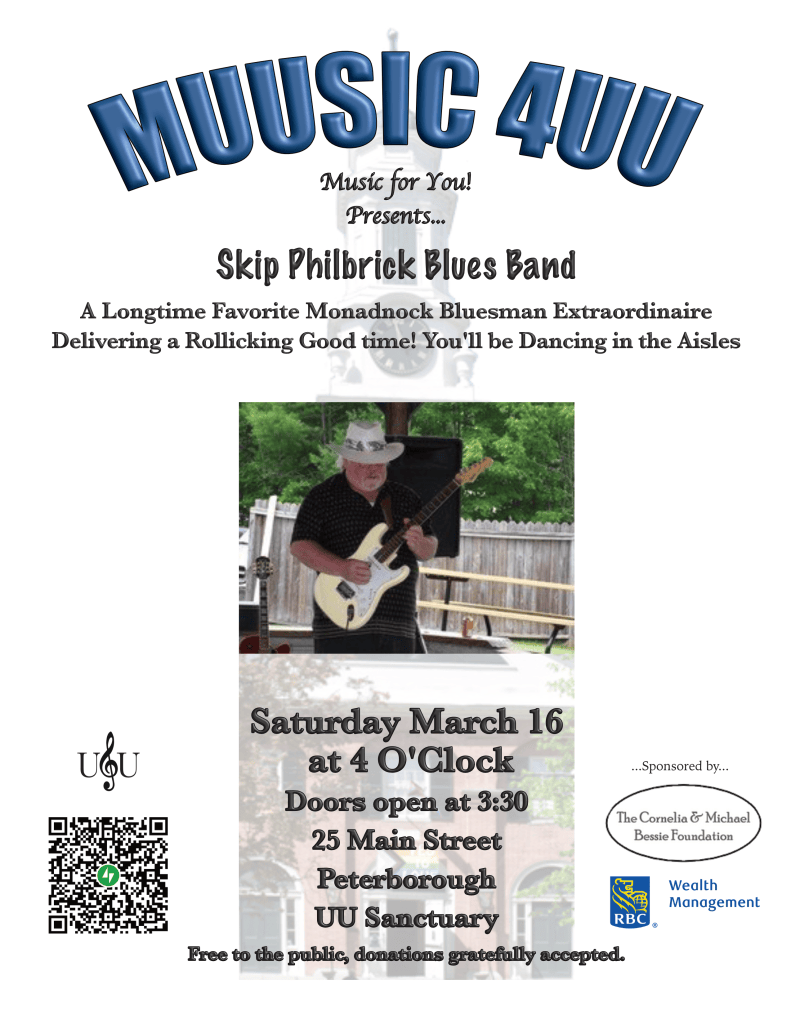
Skip Philbrick, blue guitarist extraordinaire
Skip Philbrick Blues Band, featuring Carl Querfurth on trombone
The blues changed my life. Its trajectory abruptly veered the first time I heard a Paul Butterfield album and by the time I was acquainted with Doc Watson, Elvin Bishop, Bonnie Raitt and others, I was no longer treading the path I thought I was on when I began my college years. After years of study in my own musical field (i.e. not blues) it was real treat to talk with this seasoned bluesman.
What hooked me was the vitality – I can’t even put it properly into words: When I listened to the blues I heard life. Life. Something so deep in the blood that it encompassed every yearning for existence before me. Artistic drive, carnal enthusiasm, sad joy and redemptive gumption.
Talking to Skip Philbrick is to reacquaint the self with that wild mixture of joy and anguish; something very real and fundamental to what it is to be human. Himself firmly rejecting the pull of technology (excepting a computer and his flip phone), he prefers a phone call over an email (for which he doesn’t have an account) and opened his first browser only fairly recently. While that might seem so unutterably quaint to some of us to make the outcry of “get a horse, dammit!”, it illustrates his keenly vital connection with life and with people while the rest of us are tethered to our highly addictive tech, tuning out all the rest.
Ask yourself then, what are the blues anyway? Skip has the answer and he’s here to lay it out, simply and forthrightly, on March 16 at 4pm at the Peterborough Unitarian Universalist Sanctuary.
Skip has a righteous history. Getting started in the 1970’s with his first group of long-haired kids playing bar gigs and touring the area playing late nights and sharing an apartment, he confesses that even at through all that youthful enthusiasm, that life got old. Nevertheless he had a brush with the big time when he opened for Muddy Waters in 1975. Still, being a musician and making a living at it are two different things, and he did bouts of construction work before finding a way to do just music and be able to live as well. Not an easy task and it takes some real courage.
Always preferring to be a “sideman” – that benighted job description of always being the backup and never the star – he laid down those lines for his guys, letting someone else do the vocals. Touring and playing in a blues band is a pretty porous situation. Sometimes a band will open for a more “famous” band (i.e. more recording sales, more reviews, more large venue appearances), sometimes those band members will sit in casually or get hired to be a sideman. Skip has done all of this, having worked in some fashion with Jay Geils Band, Luther Henderson, Bo Diddley, Otis Rush and Duke Robillard, among others. So, he’s walked those boards.
But he seems to have two major sources of pride, other than the frontmen he’s worked with. One is winning the 2002 New England Blues First competition and the other is the people who have come to play with him. Here’s the line-up for the Muusic 4UU concert: Mike Wakefield on sax; Carl Querfurth on trombone, Tom Wright on guitar, Richard Doerty on Bass, and Jay Crowley on drums.
Through all this, through his incisive, penetrating comments on our current American malaise, through all his own careful position vis a vis technology, he still comes off humble; a real straight-ahead guy. He even says that he doesn’t know the names of notes (although he can identify an E minor chord just fine – but no artist can be an artist without having many sides), that he’s plays all by feel and instinct.
Now, ain’t that the blues?
For more information visit muusic4uu.org
***

