Presenting … MUSIC FOR YOU!
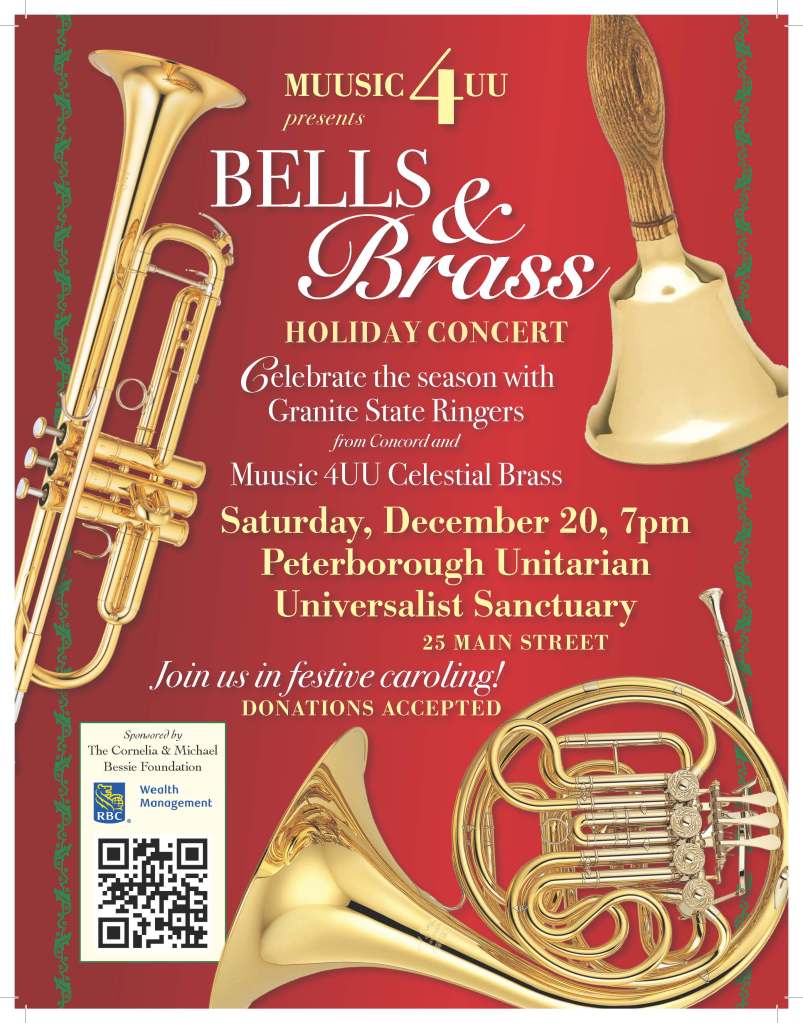
Saturday, December 20, 2025, 7:00 p.m.
Muusic 4UU Bells and Brass Holiday Concert
Featuring
Granite State Ringers directed by Joan Fossum
The Muusic 4UU Celestial Brass directed by Daniel Walker
Program
Brass
Fanfare – William Walton
Bells
O Hanukkah – arr. Eileen Laurence
Light in the Darkness – arr. Margaret R. Tucker
A Thousand Christmas Lights Are Lit – arr. Sandra Eithun Commissioned in memory of Mary Divers, Co-Founder Granite State Ringers
Silent Night – arr. Cynthia Dobrinski Kelly Brown and Meghan Fossum, Flutes
Brass
And the Glory of the Lord – G.F. Handel arr. Thomas
Christmas Jazz Suite – Bill Holcombe
Bells
Diminished Minor Alterations – arr. Chris Peck
Rondo Passacaglia – arr. Cynthiua Dobrinski
A Holly Jolly Christmas – arr. Joel Raney Hilary Justice, keyboard
Peace – arr. Kurt Meyer
Brass
Just a Closer Walk With Thee – arr. Jack Gale
Three Traditional Christmas Songs – arr. John Beyrent Good King Wenceslas Still Still Still Oh Tannenbaum
Bells
Have Yourself a Merry Little Christmas- arr. Joel Raney Laura Halleck, Keyboard
The First Noel – arr. Cathy Moklebust
Carol of the Bells – arr. Arnold Sherman
Brass
Masters in This Hall – arr. John Beyrent
Holiday Sing Along!
* * *
Program notes:
With the glint of shiny brass, and the colors of Christmas, the experience of the sight and sound of handbell choir and brass ensemble is at once festive and thrilling. We welcome the Granite State Ringers to perform for Muusic 4UU; they will join with the Muusic 4UU Celestial Brass for our third annual joyous holiday themed concert in the Peterborough Unitarian Universalist Sanctuary. Holiday favorites and a community sing along round out the program.
Out of Concord, New Hampshire, the Granite State Ringers is an elite handbell choir in New England. Founded by director Joan Fossum and Mary Divers, they have been a non-profit since 2007 with a mission to offer educational programs for youth and adults as well as concerts in support of groups in need, such as NH Food Bank and the Ukrainian Red Cross. They perform on five octaves of Malmark handbells, six octaves of Malmark handchimes, and four octaves of Schulmerich Handbells, a serious piece of change. This is an impressive array of brass: from very a large bell that commands its own table and requires some brawn to heft, to tiny bells which are frequently played “two in hand” by skilled ringers who can ring up to four bells at once.
They program is made up of their 2025 concert series, titled A Thousand Lights Are Lit, which is also the title of one of their signature pieces, which they commissioned. As a group of professional ringers, the audience will enjoy their skill on difficult tunes such as Carol of the Bells. We are incredibly lucky to have them at Muusic 4UU – the group is much in demand this time of year. To find out more about the ringers, go to their website: https://www.granitestateringers.org
A brass ensemble can come in various sizes, from a trio to a large all-brass band, but a quartet or quintet is somewhat the standard for a brass choir. There is tons of music written for this conformation – think “Canadian Brass” who for years has written, arranged and performed brass choir music resulting in (more or less) the canon for modern brass music. And among the best music is written for the holidays – cleverly arranged for smaller ensembles. The Muusic 4UU Celestial Brass includes Sheldon Ross and Richard Tandy on trumpets, David Sporny, trombone, and director Daniel Walker on bass trombone.
Singalong Lyrics

O Come All Ye Faithful
O come, all ye faithful, joyful and triumphant
O come ye, o come ye to Bethlehem
O come and behold Him, born the King of Angels
O come, let us adore Him …
Christ the Lord
O sing, choirs of angels, sing in exultation
O come, o come ye to Bethlehem
O come and behold Him, born the King of Angels
O come, let us adore Him …
Christ the Lord.
Joy to the World
Joy to the world, the Lord is come
Let earth receive her King
Let every heart prepare Him room
And Heaven and nature sing
And Heaven and nature sing
And Heaven, and Heaven, and nature sing
He rules the world with truth and grace
And makes the nations prove
The glories of His righteousness
And wonders of His love
And wonders of His love
And wonders, wonders, of His love
O Little Town of Bethlehem
O little town of Bethlehem
How still we see thee lie
Above thy deep and dreamless sleep
The silent stars go by
Yet in thy dark streets shineth
The everlasting light
The hopes and fears of all the years
Are met in thee tonight
For Christ is born of Mary
And gathered all above
While mortals sleep, the angels keep
Their watch of wondering love
O morning stars together
Proclaim thy holy birth
And praises sing to God the King
And peace to men on earth
Angels We Have Heard on High
Angels we have heard on high,
sweetly singing o’er the plains,
and the mountains in reply
echoing their joyous strains:
Refrain:
Gloria, in excelsis Deo!
Gloria, in excelsis Deo
Shepherds, why this jubilee?
Why your joyous strains prolong?
What the gladsome tidings be
which inspire your heav’nly song? [Refrain]
Jingle Bells
Dashing through the snow
In a one-horse open sleigh
O’er the fields we go
Laughing all the way
Bells on bobtails ring
Making spirits bright
What fun it is to ride and sing
A sleighing song tonight
Jingle bells, jingle bells
Jingle all the way
Oh, what fun it is to ride
In a one-horse open sleigh, hey
Jingle bells, jingle bells
Jingle all the way
Oh, what fun it is to ride
In a one-horse open sleigh
A day or two ago
I thought I’d take a ride
And soon, Miss Fanny Bright
Was seated by my side
The horse was lean and lank
Misfortune seemed his lot
He got into a drifted bank
And then we got upsot
Jingle bells, jingle bells
Jingle all the way
Oh, what fun it is to ride
In a one-horse open sleigh, hey
Jingle bells, jingle bells
Jingle all the way
Oh, what fun it is to ride
In a one-horse open sleigh
Silent Night
Silent night, holy night!
All is calm, all is bright.
Round yon Virgin, Mother and Child.
Holy infant so tender and mild,
Sleep in heavenly peace,
Sleep in heavenly peace
Silent night, holy night!
Shepherds quake at the sight.
Glories stream from heaven afar
Heavenly hosts sing Alleluia,
Christ the Savior is born!
Christ the Savior is born
Silent night, holy night!
Son of God love’s pure light.
Radiant beams from Thy holy face
With dawn of redeeming grace,
Jesus Lord, at Thy birth
Jesus Lord, at Thy birth
A Warm and Loving Holiday Season to Everyone!
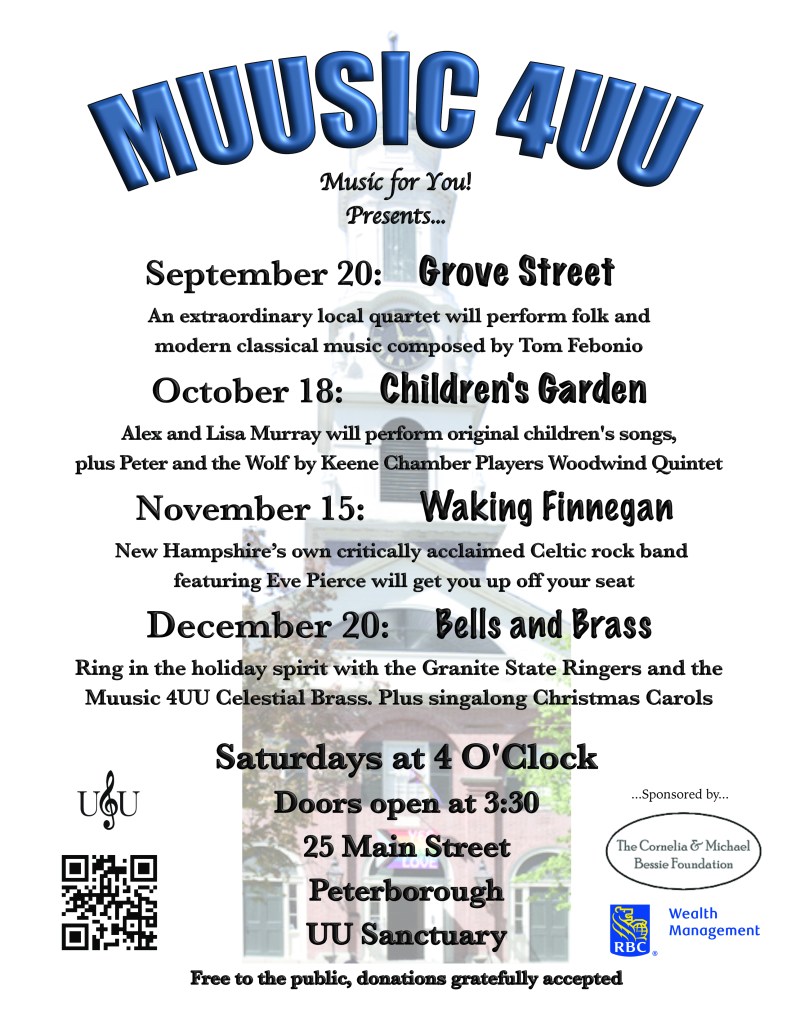
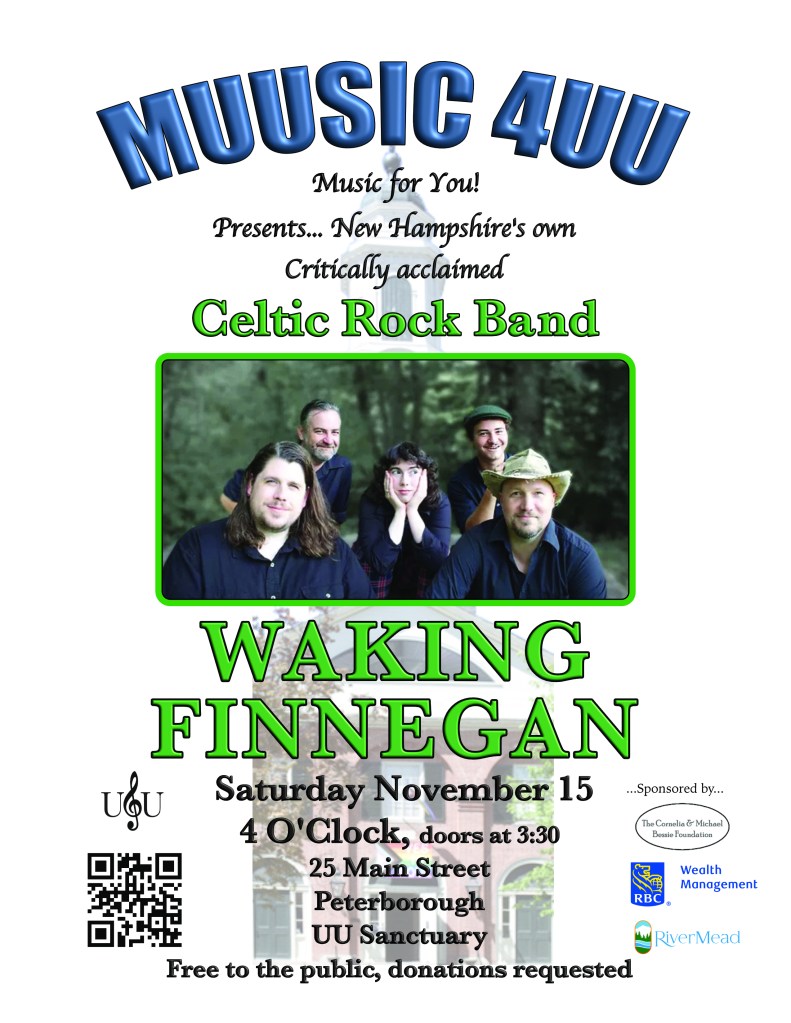
Maple Grove to play on November 15th
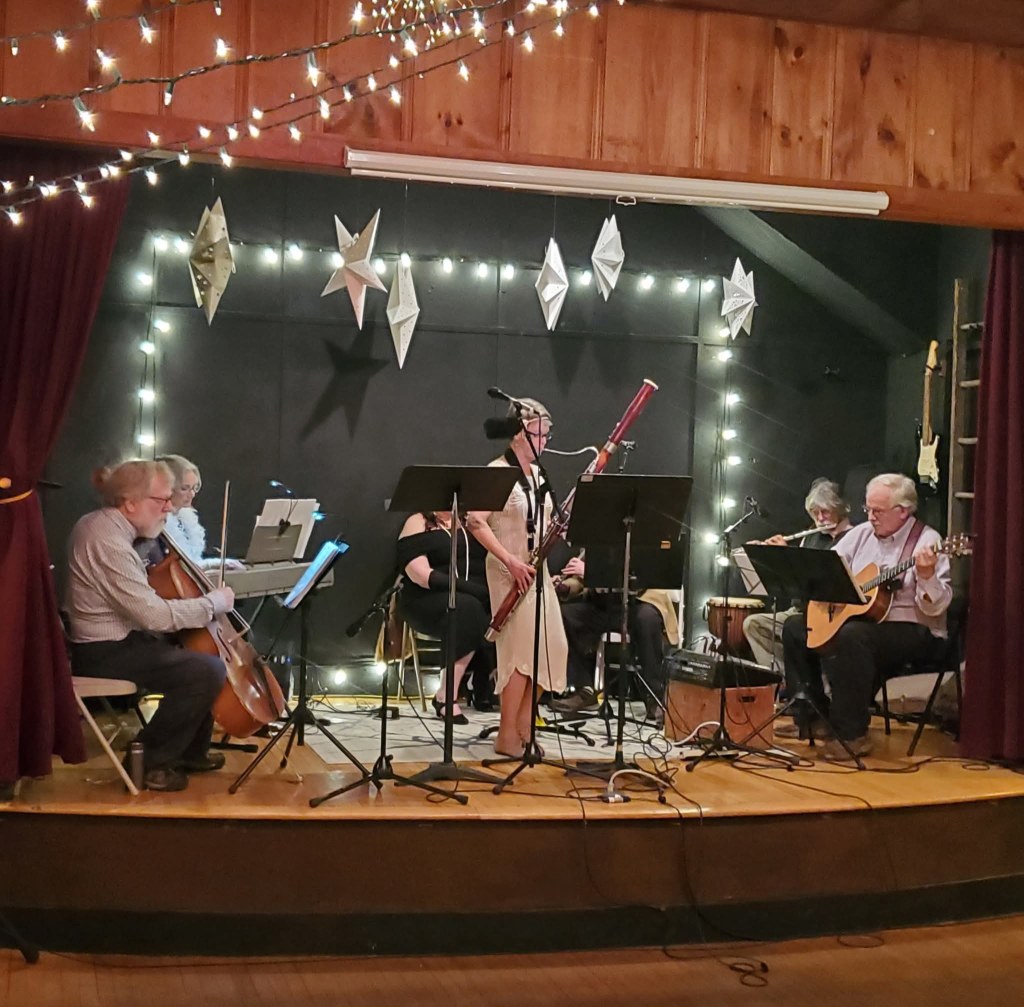
Due to unforeseen circumstances, Waking Finnegan will be moving their performance to Spring of 2026. However, don’t despair, The Show Must Go On.” Come support newly formed “Maple Grove” who have graciously stepped in for this Saturday with their Roaring Twenties Sound. Come prepared for fun and dancing. You are welcome to dress the part and join in the fun if you’d like to Charleston. See you Saturday at 4 in the Sanctuary of the Peterborough Unitarian Universalist Church, 25 Main Street, Peterborough NH. Maple Grove includes the musicians of Grove Street and Maple TreeO: Eric Blackmer, guitar, Lisa Murray, piano, David Duhon, cello, Joy Flemming, bassoon, Chaz Beaulieu and David Flemming, flutes, and features vocalist Alex Murray. For more information email muu4uu@gmail.com.
* * *
A quiet act of rebellion.
There’s more to Peter and the Wolf than meets the eye. It is by turns, educational, an allegory to Common Virtues, a piece of programmatic minimalist composition, and the kicker – subversive as heck.
The history of how this piece came into being is relevant: Peter and the Wolf was commissioned by the director of a Moscow children’s theatre in 1936. Prokofiev was intrigued by the idea of writing a piece that would introduce children to the different instruments of the orchestra as well as to the concept of leitmotif, or the use of themes to identify character, in a programmatic composition.
He wrote the entire work, libretto and music, in about two weeks. The inside story, perhaps apocryphal, that I always heard from one of my New England Conservatory professors was that Prokofiev composed the leitmotifs without using the piano at all – strictly from the inside of his own ear.
The libretto came about because Prokofiev rejected the poem by a popular author of children’s books, Nina Sakonskaya who, to be fair, had also been commissioned by the aforementioned theatre director. The story goes that Sakonskaya knocked on Prokofiev’s hotel room door, poem in hand, to pitch her story. There is some question whether the composer simply didn’t like the story or whether a door knocked in the night in Stalinist Russia triggered in him existential PTSD such that all further consideration was instantly cast off. Expunged.
But in fact, there was an atmosphere of institutionalized fear in which Peter and the Wolf was created. And it is by pure luck that the work escaped scrutiny and subsequent suppression by Soviet authorities. As it happens, at the time Peter and the Wolf premiered in May of 1936, Dimitri Shostakovich was under fire for his compositions. The Great Terror in the Soviet Union began early in 1936, a time when many composers, writers and artists were imprisoned, killed or disappeared. Shostakovich in particular had been denounced recently due to his opera Lady Macbeth of the Mtsensk District, written and premiered two years before in 1934. This very popular opera was the one that Joseph Stalin had publicly stormed out of in January, putting Shostakovich in the crosshairs of the authorities and causing many citizens to keep a go-bag by the front door. Things went downhill from there.
So Peter and the Wolf was somehow able to run under the radar at a time when works deemed subversive by the party apparatchiks were lit up like fireworks. But maybe a children’s fairy tale of a boy defying his guardian to go play in the forest with his animal friends and encountering a wolf is too innocent to be subversive.
Let’s take a look. According to my sources, in the original poem by Sakonskaya that Prokofiev rejected, Peter was a Russian pioneer, going off to join the Komsomol – the Soviet youth army, much like the Nazi youth forces in Germany during the same time period. Prokofiev’s Petermay be introduced as a pioneer, but his story is one of facing a threat from without. Peter is both rejecting his Bolshevik grandfather and the creeping fascism and totalitarian state. After all, wasn’t the duck disappeared? Is the wolf representative of the threat of Nazi Germany, or the threat from Stalinist Soviet Union? It doesn’t really matter – any child listening will instantly understand an existential threat from a powerful force of destruction. And parents tending that go-bag will look at each other and keep very, very quiet.
Either way, the hunters are there to destroy or contain the wolf – these brave heroes who are there to protect and serve rather than threaten or imprison. In the mind of the child of those times, Western Democracy was always the beacon of hope for peace and freedom. And Prokofiev tapped into that. Perhaps the secret police was preoccupied with capturing bigger fish. But this work is not as apolitical as it appears. Without political trappings, life is about hope, joy, even a jaunt in the sun-drenched fields beyond the fence.
What is more interesting is that not only did Peter and the Wolf escape denunciation, but it nearly simply faded out. It became the world-wide phenomenon it is because of champions in the west in the guise of the Boston Symphony Orchestra and Walt Disney. Prokofiev was allowed to travel to the United States in 1938 and had access to major promoters of arts and entertainment. The BSO recorded the piece in 1939, the Walt Disney short came out in 1946. During that time, performances were scattershot, but it took off post-war and became what it is today.
* * *
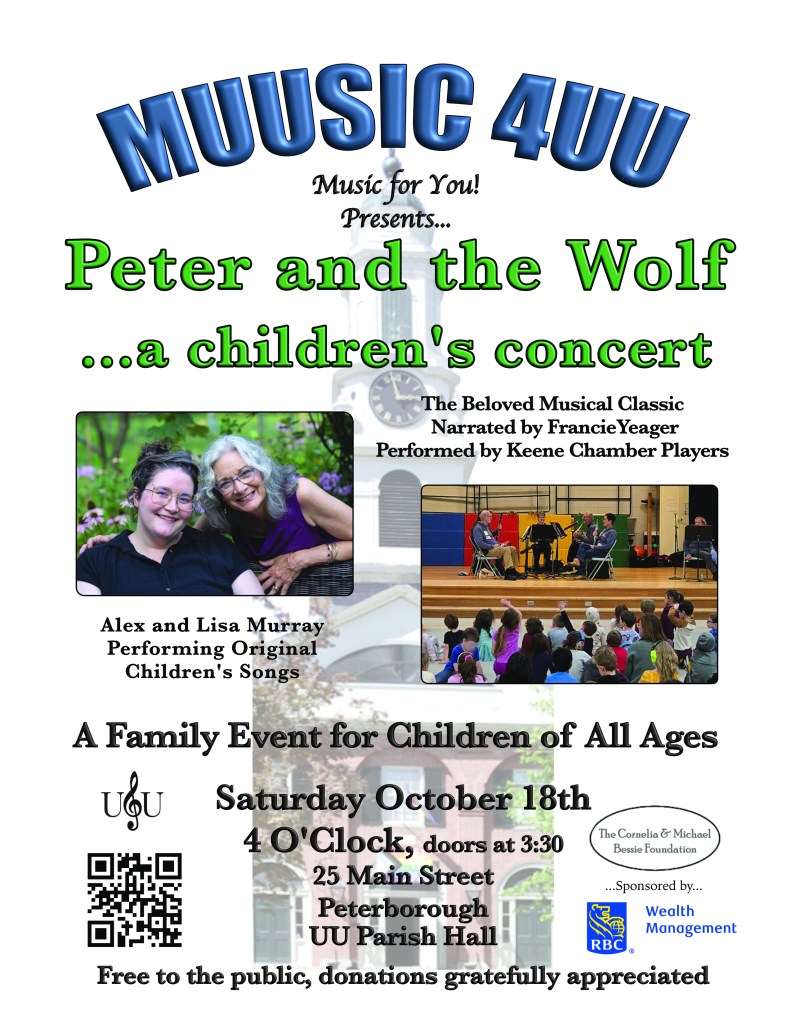
Lisa Murray is known about town for her pianistic skills as a teacher, accompanist and sideman. She has been spotted in various churches and theatres in the area and is currently performing regularly with Grove Street.
Her compositional work goes back a number of years, having recorded her delightful folk-rock inflected songs with Eric Blackmer and Charlie Metzler. And her piano works are deep and lush within a minimalist framework; it’s easy to lose oneself in a meditative, peaceful place with the headphones on listening to Lisa’s expressive playing.
Her children’s songs are a relatively recent fork in the road for her, the inspiration for such bubbling forth (her words, aptly enough) from her relationship with her grandchildren. Her partner, Alex Murray, is also her niece, and their musical relationship is relatively recent. Lisa’s gives more depth to the story:
My niece Alex came to visit two years ago from Washington, DC, and started singing one of my original songs that I was playing on the piano. I was reminded of how great her voice is, and asked her to make music with me somehow. We began to ‘meet’ over Zoom and the phone a couple of times a month to write songs and work on music, eventually performing at Porchfest outside of Philadelphia. Alex moved in with me and my husband last March, and we have since done some open mics as well, and a show at the Monadnock Country Club this past summer. Our songwriting has evolved to include children’s songs, spurred on by the first few I had written for my grandchildren. I plan to make videos of these and make them available on YouTube.
Lisa’s works can be found on her bandcamp channel: https://lisagailmurray.bandcamp.com/
* * *
The quintet performing Peter and the Wolf and other music this afternoon is an comprised of members of the Keene Chamber Orchestra. Flitting about like a bird on flute is David Flemming, on oboe, the soon-to-be eaten duck is Jodie Hoye, Cora Dykens is sneaky as a cat on clarinet, Joy Flemming provides the essential grumpy grandfather on bassoon, and David Miller comes in from the forest like a wolf on horn. If some of the names seem familiar in our Muusic 4UU circle, you won’t be wrong.
* * *
Sources:
Peter and the Wolf, Wikipedia https://en.wikipedia.org/wiki/Peter_and_the_Wolf
Peter and the Wolf at 80: How a children’s classic survived Stalin… and Disney, BBC Arts, May 2, 2016. https://www.bbc.co.uk/programmes/articles/QT8ZpYVZXv5jyWHnpbsrHw/peter-and-the-wolf-at-80-how-a-childrens-classic-survived-stalin-and-disney
Dimitri Shostakovich, Wikipedia https://en.wikipedia.org/wiki/Dmitri_Shostakovich
GROVE STREET returns to the Muusic 4UU stage!
(Scroll to the bottom for setlist.)
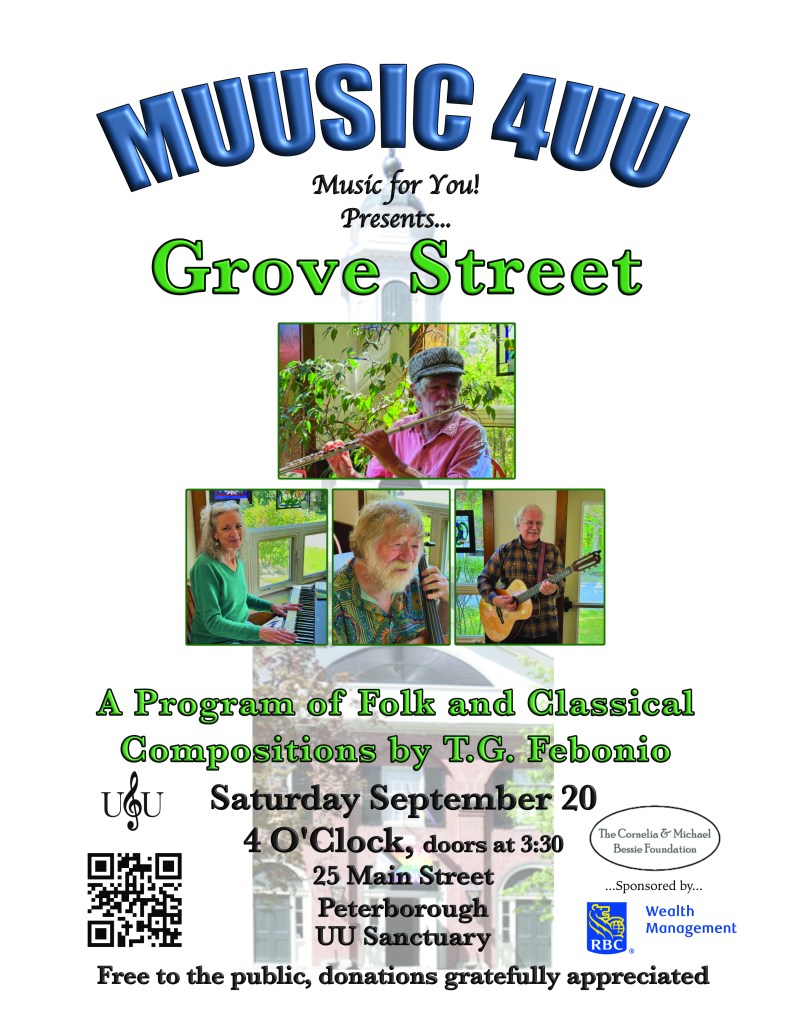
The Grove Street ensemble is one of those musical concatenations that seems to morph on occasion, growing or shrinking with the needs and circumstances of the times or a particular gig. Nevertheless, this group of musicians that play mostly Celtic music (one of the members actually having a claim to Irish heritage!) has been around for quite a number of years, often being seen at the Bagel Mill Cafe, which happens to be on Grove Street in Peterborough (think it’s a coincidence?).
They’ve played for the Muusic 4UU series before — in our first season — and they were wonderful. This time around, they’re featuring mostly tunes by Tom Febonio, but more about him later. First, let’s introduce Grove Street’s members, now as a quartet including pianist Lisa Murray, joining Chaz Beaulieu (flute), Eric Blackmer (guitar), and David Duhon (cello). Chaz and Eric have been playing together for over 15 years in a number of different groups. David joined them about 5 years ago and Lisa, who is quite the gal around town, joined about 2 years ago. Full disclosure: Eric is a member of the committee that organizes the Muusic 4UU concert series.
This concert is themed; most of the works performed in the Muusic 4UU venue are written by composer Tom Febonio. Grove Street became acquainted with the music of Tom Febonio through Chaz, who was pals with Febonio back in college days. But the composer’s work runs through many layers of the Grove Street experience — David was networked into the circle through an appreciated of Febonio’s work, and Chaz is remembered in a number of the composer’s dedications. So, an “official” bio is needed here:
Tom Febonio was born in Salem, Massachusetts in 1950 and began his career in music at the age of sixteen playing electric bass in a rock & roll band. This kept him occupied for about a decade, during which time he took up songwriting and recording, traditional music and jazz. Tom’s compositions to date are mostly tonal and structured along classical or romantic lines, and include solo and chamber pieces for piano, guitar, mandolin, strings and winds. A number of these works are available from ALRY Publications, Forton Music, Guitar Chamber Music Press, Joachim-Trekel-Musikverlag, and VCello Music Publications. He currently resides in Rockport, Mass.
The intersection of traditional, Celtic and jazz is something of a mainstay here at Muusic4UU. Of the tunes you can expect to hear, The End of August is bouncy and jazzy and breaks into improv; Frost Runes has a very Renaissance feel in its simplicity, modality and changing meter. Mrs. Edison’s Rag is straight-ahead ragtime and will have you cakewalking. Her Eyes Were Blue Sometimes Green has a definite bossa feel.
But the tribute to Febonio’s musical depth and intelligence is best said in the words of members of Grove Street:
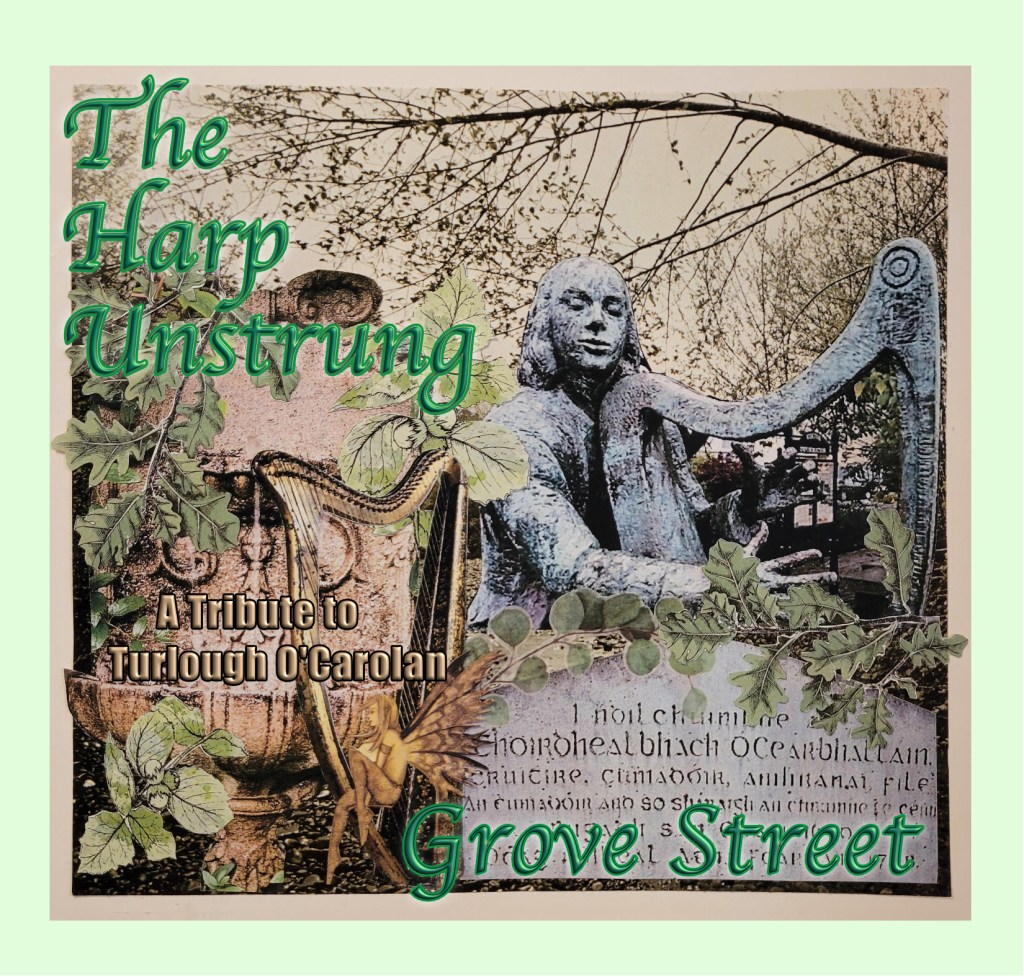
We dearly love Tom Febonio’s work and have been working on a concert featuring his work, as well as a CD of it, for several years. We recently produced a CD called The Harp Unstrung, a tribute to Turlough O’Carolan. We plan to release a similar CD dedicated to Tom Febonio compositions within a year.
I think you’ll love these works as well. Enjoy!
| End of August Street Piper Munimula into The Devil Went West Her Eyes Were Blue Scottish Eldorado Freeway Letter from Home /Tundra Dance Her Eyes Were Blue Sometimes Green | Mrs. Edison’s Rag Frost Runes Polka Ballads # 1, 2 & 3 Quatro Canzoni #1, 2, 3 & 4 Alma #1, 2, 3, 4, 5 Soul Cake (not Febonio) |
* * *
September 20, 2025 at 4 p.m.

