Presenting … MUSIC FOR YOU!
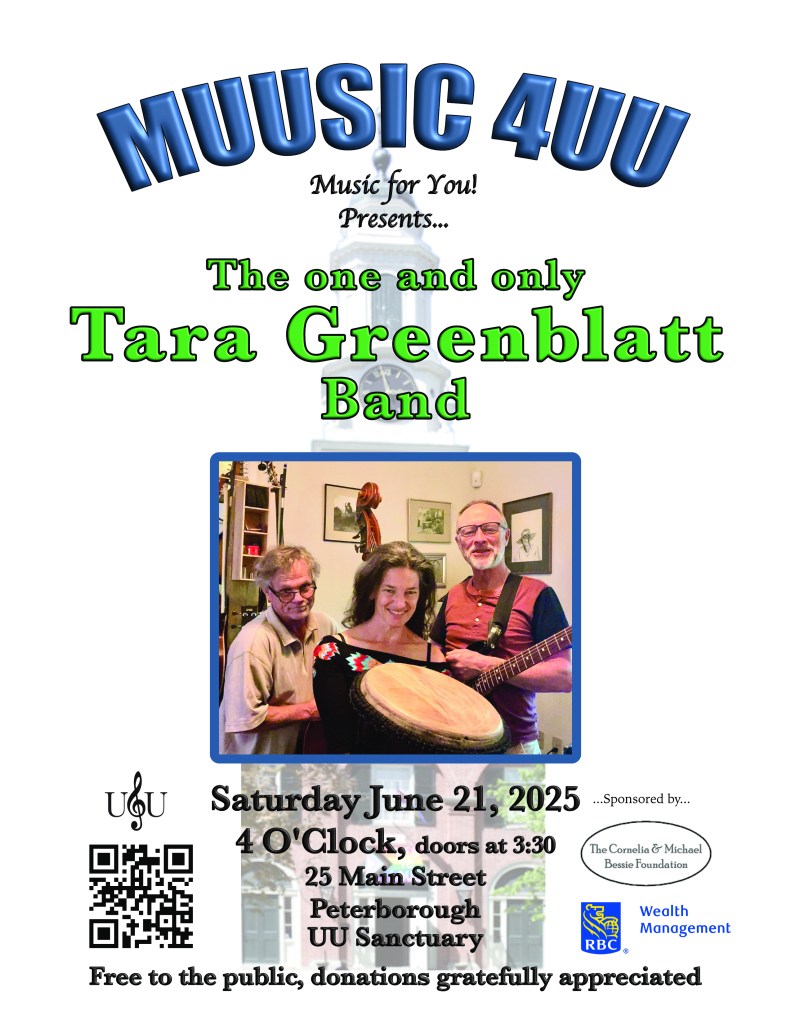
How to Support a Music Habit
Making a living as an artist of any stripe has been difficult in the best of times. We don’t live in a culture that celebrates creativity or creative output in a way that actually supports the artist. Our culture loves having it around, loves going to concerts, relishes the spoils of a craft fair or an art show, but to actually support the producer of these beautiful things …?
But we live in the times we live in. Mozart came out of a system of patronage created by the ruling families of the Austrian court, but rejected (or was rejected by) it evidently finding the effect on his creative freedom chilling. However, Mozart wasn’t a savvy business person – he gambled and lived a high life and died poor. Two other composers did pretty well for themselves – Beethoven, whose years crossed Mozart’s, also shunned aristocratic patronage (which was in decline by that time anyway) but he became something of a rock star for his time and did well. Go back another generation from Mozart and there was J.S. Bach who was a great businessman besides being a brilliant composer. Bach made use of Patronage when it suited him, worked as an 18th century gig worker when it didn’t, and somehow managed to support his two wives and 21 children.
But these days, musicians are subject to something much more oppressive than an aristocracy – we are working in a system controlled by the Music Industry where an artist develops a lucrative career that depends entirely upon airplay and optics that make money for the Music Industry. So how do we support our creative urges?
Tara Greenblatt is a musician who has had to configure a life that works for all aspects of her multidisciplinary life. We know her as the drummer and vocalist whose music has “rolling infectious rhythms and a soulful soaring voice alive with the pulse of life.” But we wanted to find out a little more about who the person is, how she has managedto balance creative output with practical need and how her life has morphed with the times. She told me what she is up to, revealing that she’s studying Radiology Tech after some years as Program & Project Manager at River Mead.
That’s where our conversation started:
As you develop new career plans outside of music, how did you come to Radiology?
The first two years after my divorce back in 2020 was for healing and regrouping. The third and fourth years were about figuring out what it will take for me to achieve financial security on my own to see me through to the end of life. I also wanted to position myself someday to: own property, have assets to hand down to my two children, carry health insurance, have money available for unplanned events my kids or I may experience, and some disposable income for travel. I searched for what this would be through a process of elimination for about two years.
Almost every girl has dreams of the future that include the arts, usually along the lines of wanting to be Taylor Swift. For me at age five, I wanted to be a ballerina. How were you drawn to music in your younger years?
Music has been a part of my life all of my life. My Mother raised my sister and I to balance art-making with living life and working. We were very fortunate to have this modelled for us. Now that I am as established musically as I care to be, and since my children are now 16 and 21, there is space for me to dive back into a new career path while keeping connected musically.
Is a dual career something you do out of necessity or as two streams of what you want to do with your working life?
Music is not a revenue stream for me. I don’t consider my music making or performing a career. I have never wanted to position my creativity towards revenue because the pressure and stress of having to produce shuts me down. I actually work well under pressure generally. I can invent a goofy song out of the blue improvisationally, I can riff, come up with ideas impromptu, but that’s when the environment is light weight, uninvested in some kind of product that I or someone else wants or needs to profit off of. Writing songs does need some pressure under it in order to come to fruition, but not the kind where bills, food, or shelter rely on it. I have always been driven by security and stability because there wasn’t much of it in my early years of childhood. Art and creativity are like sacred well springs that a steady job guards the sustenance of.
In busy times, what does your day look like? Any issues with getting time off, are you scrambling to keep all your ducks in a row?
Regular rehearsals are what to tether me to my music. Time management is my friend when it comes to maintaining a healthy balance between work and creativity. I used to work at songwriting and melodies for hours. These last few years and for the next two and half years I have made an agreement with myself to focus mostly on work and school. The music will have to slip through the cracks in the wall. I will have to pay attention, watch the wall for leaks, collect the drippings in fits and starts, and write a little here and there. That is ok. I am making a major life change for the better. I believe a woman should make her own dough, and we have to work hard in this world to create stability.
We sure do! But how do you manage the intersection between “work” life and music life?
I manage the intersection between work and life with a mind set of practicality. I leave my drum set set-up and available, and my writing book near my bed. Pens everywhere. No excuses, the sticks and the drum set are right there in front of me. Even 10 minutes grounds me. I record songs using my voice recorder on the phone. I trust that there will be moments to visit my inner well where songs get made. Ultimately, work is the foundation. When I am financially stable I have the internal space to be creative.
That mind set of practicality – what a resource for any artist of any kind! We all could take a page out of Tara’s notebook. But often for the musician, it’s not about supporting the habit, rather creating good habits that support our music.
* * *
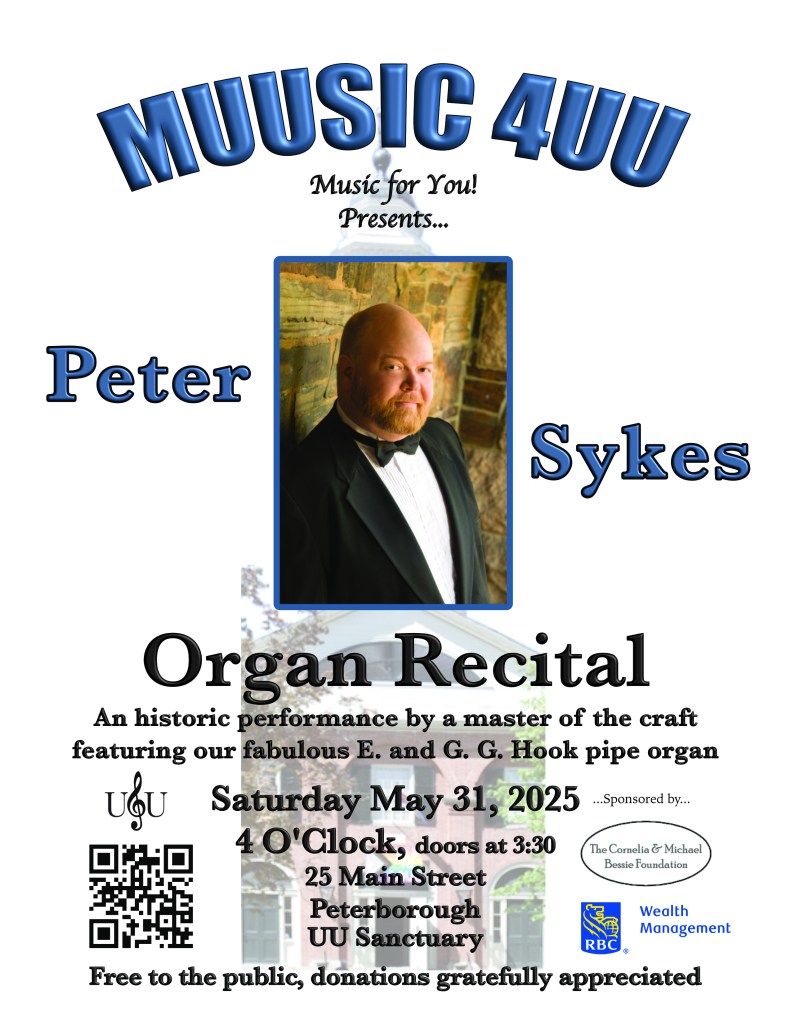
Exploring the world’s most complicated musical instrument
Let’s face it, for many people an Organ Concert is much like an Opera Concert – something for the diehard afficionado. So instead of trying to convince the listener that this is something they have to love because, well, it’s art and you’re supposed to appreciate it, we decided to answer a few questions about the instrument and the music with the idea that with more information you, dear listener, will open your mind and heart to this marvelous sound. I asked around and compiled a list of some basic questions. Read and enjoy!
What is the oldest keyboard instrument?
By all accounts, the organ’s evolutionary precedent is the oldest keyboard instrument. I was surprised by how old it is, dating back to the 3rd century BC with an instrument called the hydraulus. This was a bellows-driven instrument with a bag of air inserted into a basin of water. As the bellows are pumped, the air gets pushed through the water and then exits through a set of pipes. That air is released by wooden levers. Follow the line and you’ll hear it makes quite a pleasant sound.
. Keys were also not always keys, but buttons or wooden plungers that were pushed by the player’s entire hand. Whack-a-mole with musical notes!
How do modern organs work?
All those pipes you see up in the organ loft are set up in groups by sound, or ranks. Each pipe can only play one note, so each rank has a set of pipes equal to the entire keyboard. That’s a lot of pipes! The sound or timbre of each pipe are grouped into ranks partly by their material (wood or metal – in old times that could be lead) and their construction (fipple like a recorder or reed like a clarinet).
What are “Stops?”
Stops are the knobs or levers above or on each side of the keyboard. The term ‘stop’ was one I could never quite wrap my head around, because the act of pulling a stop didn’t seem like you were stopping anything. You aren’t. When you pull a stop you are really opening the stop which allows air into the pipes. So I guess you could call a stop a ‘start,’ which might be a bit more accurate. Stops are called by all kinds of interesting and arcane names, like diapason, bourdon, principal, keraulophon, nazard and tierce, but also more familiar names like flautino, violino and oboe. The stops are generally arranged to associate with different keyboards. Think about the old aphorism: pull out all the stops. You’ve got everything going at once.
Why so many keyboards?
There can be up to five keyboards on an organ, called manuals. Your typical church organ generally has two, sometimes three. The manuals are set to control a specific set of ranks of pipes which kind of answers the question: it’s to give the instrument the widest variety of sounds with plenty of flexibility and ease to move from one sound to another. A good player can make a single piece of music sound like an orchestra (although you can always tell the difference between an orchestra and an organ). Keyboards are generally named Swell and Great, the third keyboard when there is one is generally called the Choir. I don’t know why the manuals are thus named and Wikipedia didn’t help me on that one. Organ keyboards are shorter than a piano keyboard, with about four octaves per manual as opposed to seven on a piano.
What up with those pedals?
More like down with the pedals, but the footboard, or set of pedals, is unique to the organ. It’s set up like a typical keyboard with “white” keys (generally brown) interspersed with black keys just like a piano, only larger. The pedals cover about two octaves (I can’t imagine trying to play four octaves with my feet!) and their sound is in the lowest range of the instrument. So pedals provide the basso profundo part of an organ piece. The pedals are attached to their own ranks in the pipes and there are stops associated with them as well, just not as many. There are also linkages between the keyboard stops and the pedal, so you can get a wide range of timbre and quality of sound coming from the pedals.
Is it hard to play?
Well, a novice definitely starts to feel like a three-armed paper hanger while learning! For me, switching between keyboards was never a problem, although I understand for some it is difficult. If a player has basic proficiency on the piano and is a decent reader, the organ is quite accessible and very fun to play. Pulling the stops can be very tricky, though, because there is a timing issue – closing and pulling four or five stops between sections of a piece of music takes time so there is the hesitation factor to overcome. A player has to have digital expertise (aka fast fingers) or the music sounds jerky. One of the best things about the Hook organ is that in the rebuilding of it they added pre-sets – the organist’s boon. So you set up what stops you want to use to change the sound of a piece of music, hit the pre-set button and voila! all you have to do is push one button as you play and your piece goes on without a hitch.
On the other hand, the pedals are a game changer. Unless you naturally have a lot of coordination, a novice will struggle to perfect Fred Astaire-like fancy footwork. For me personally, I could never sort out what my feet were supposed to do in counter with my left hand. If the pedal notes on the page were written higher than the left hand notes, I could sit for hours trying to figure it out. For most, though, I think it’s about accuracy. You can’t look at your feet (nor should you be looking at either hands or feet — eyes on the music!) so you need to feel the distance between a low C and a D an octave away. So be forgiving when you hear some odd sounds coming from the low end of an organ piece!
Is it different to play from the piano?
Not very in terms of basic reading. Beginning organ music puts the pedal notes on the same staff as the bass clef (left hand). More advanced music gives the pedals its own line, so there’s an expansion of your visual acuity required. But the touch of an organ is quite different and the player has to learn some different technique, mostly around sustaining notes. On the piano you sustain notes with the damper pedal. On the organ, you must sustain notes with your fingers since your feet are playing actual bass lines. This means that the player has to develop a lot of independence between fingers so that some fingers can hold notes while other fingers are playing lines. Most modern organ music is written with this in mind, though, so well-written music sets it up for you. One little bump is that organ keys are just a teensy bit narrower than standard piano keys, so there’s a bit of an adjustment there. Setting stops is immensely fun – you go through a piece to figure out how you want it to sound and the effect you want. Then you jot those stops onto the music and off you go. There’s a lot of artistry in the process of making a piece of music your own.
I hope this gives you, the reader, a little bit of insight into this fascinating and wonderful instrument. Obviously there is a lot more to be said, so I encourage you to discover more. Read about the history and restoration of our Hook organ with this link here.
~Lucinda Ellert
Program
Artist Bio
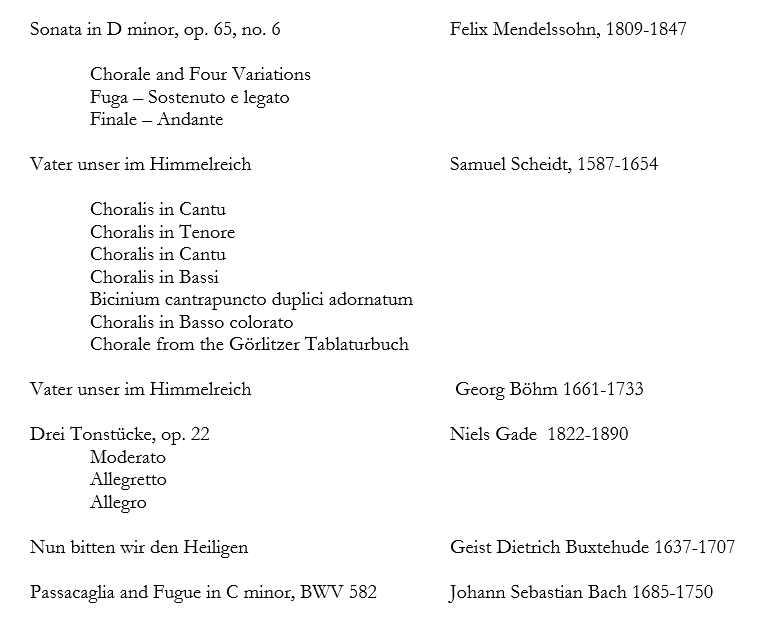
Bio Peter Sykes is a distinguished keyboard artist giving compelling, moving and accurate performances. He gave the opening recital after our organ was restored in 2004.
He holds degrees from the New England Conservatory and Concordia University in Montreal. He won the Chadwick Medal from the New England Conservatory for outstanding undergraduate achievement, and also won the school’s annual concerto competition, playing Frank Martin’s Harpsichord Concerto. His award notifications define him as “A major musical intellect and imagination of our time.”
Peter’s emotive and precise performances have been played internationally. His recordings include works on a variety of keyboard instruments including organ, harpsichord and clavichord.
In demand as a mentor for aspiring professional performers, he is Associate Professor of Music and Chair of the Historical Performance Department at Boston University. In the spring of 2014 he was invited to join the faculty of the Historical Performance Department at the Julliard School of Music as its principal harpsichord instructor. Since 1985 he has served as Director of Music at First Congregational Church in Cambridge. He is Chair of the Organ Library Committee of the Boston Chapter of the American Guild of Organists and has adjudicated competitions sponsored by that Guild, the Royal Canadian College of Organists, the Bach International Harpsichord Festival in Montreal, the Broadwood Harpsichord Competition in London and the Miami International Organ Competition. As a member of the board of the Cambridge Society for Early Music, he is a founding board member and current president of the Boston Clavichord Society.
* * *
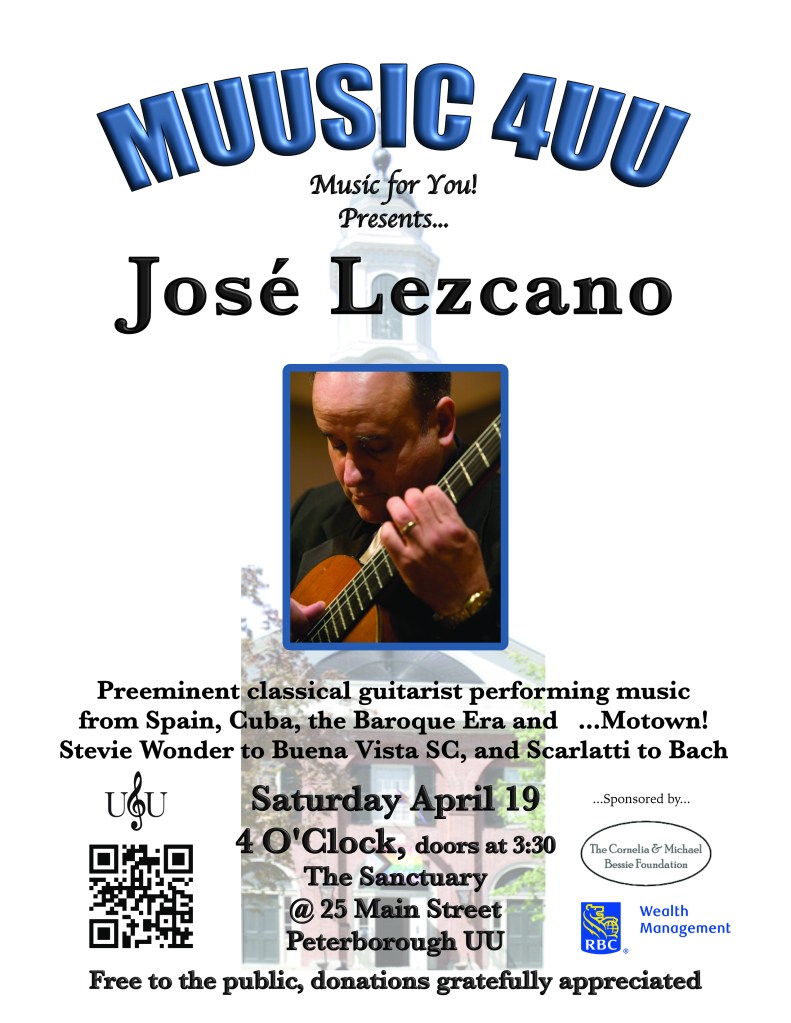
Divine Speech: Music and the Language of Community
An eleven-year-old boy living in Florida takes an interest in playing the guitar after hearing a record album of Andrés Segovia; his parents gift him an instrument along with lessons and soon thereafter, just months really, this child has acquired enough skill and repertoire to perform an entire concert from memory.
This kind of thing doesn’t seem to happen that much any more — at least we don’t hear about it as much. But the intense need to communicate using a language other than speech — in this case music — has always existed in our species.
José Lezcano was just that Florida child and his music still speaks volumes to this day. His accolades are a matter of record: visit his website to read about his grammy nominations, awards and his fascinating concert/lecture series. But the real modus operandi of this musician is the passion with which he lives, breathes, shares and speaks the language of the guitar. That language includes stories — the histories, canticles and poetry of the instrument and his own stories of his career. Even the recounting of that first concert (“I got a standing ovation and I said to myself, this is what I want to do.”) speaks of a yearning to communicate an enthusiasm that is as much spiritual as it is prosaic.
The polyglot nature of Lezcano’s approach to music extends to his programming. On one hand he gives a description of the sometimes raucous Ecuadorian Cayambe with such love, but then programs Stevie Wonder’s gentle, jazzy Overjoyed. It may seem that the two don’t share enough in common to find mutual understanding. But Overjoyed with all its complex harmonic structure and serpentine melody played as a bossa makes perfect sense with Cayambe guitars that were created by jerry-rigging the instruments with added strings and odd tunings, initially done as a form of protest against the Spanish Inquisition.
In learning about Lezcano’s choices for this program I discovered that Dominico Scarlatti, that Italian baroque composer that wrote grand masses with orchestra and chorus also wrote delicate guitar solo works with a distinctively Spanish rhythm. These and the self effacing humor of Brazilian love songs against sad melodies bring together a sense of the way music manages to convey a connection that tells a story with a deep message: because of inherent disagreement between form and function, because there is contrast between high and low art that can be alarming, this is who we are as a people.
During my research, I came across an interview that Lezcano did with the Keene Sentinel some years back. He spoke of how deep music goes to the very heart of us: “Music is a divine speech,” he said. I asked him how he hoped to provide Sanctuary in our Sanctuary, given the current mood of the times. His reply: “What we learned during the pandemic is that music provides community and solace and makes us feel less lonely. If you play happy music it lifts your spirits, if you’re feeling sad, it makes you feel better.”
Isn’t that why we’re here? To commune with something greater than ourselves and improve our lot in the process?
Program
“Music from Spain, Cuba, Brazil, the Baroque, and Motown”
Overjoyed Stevie Wonder (b. 1950) arr. Lezcano
Capricho Arabe Francisco Tárrega (1852 – 1909)
Sonata K. 178 Domenico Scarlatti (1685 – 1757)
From the First Cello Suite, BWV 1007 J.S. Bach (1685 – 1750)
- Prelude
- Sarabande
- Courante
Sonata K. 11 Domenico Scarlatti (1685 – 1757)
Three Cuban Contradanzas (1890) Ignacio Cervantes (1847 – 1905)
- El Velorio (The Wake)
- Adios a Cuba (Farewell to Cuba)
- Los Tres Golpes (The Three Knocks)
Variations on a theme by Mozart, op. 9 Fernando Sor (1778 – 1839)
Intermission
Etude no. 1 in E minor Heitor Villa-Lobos (1887 – 1959)
Si Ela Perguntar Dilermando Reis (1916 – 1977)
Buena Vista Social Club Suite, arr. José Lezcano
- Chan-chan Compay Segundo (1907 – 2003)
- Dos Gardenias Isolina Carillo (1907 – 1996)
- Veinte Años Maria Teresa Vera (1895 – 1965)
Bolero Manaba José Manuel Lezcano (b. 1960)
Serenata Española Joaquin Malats (1872 – 1912)
***
Spring 2025 schedule:
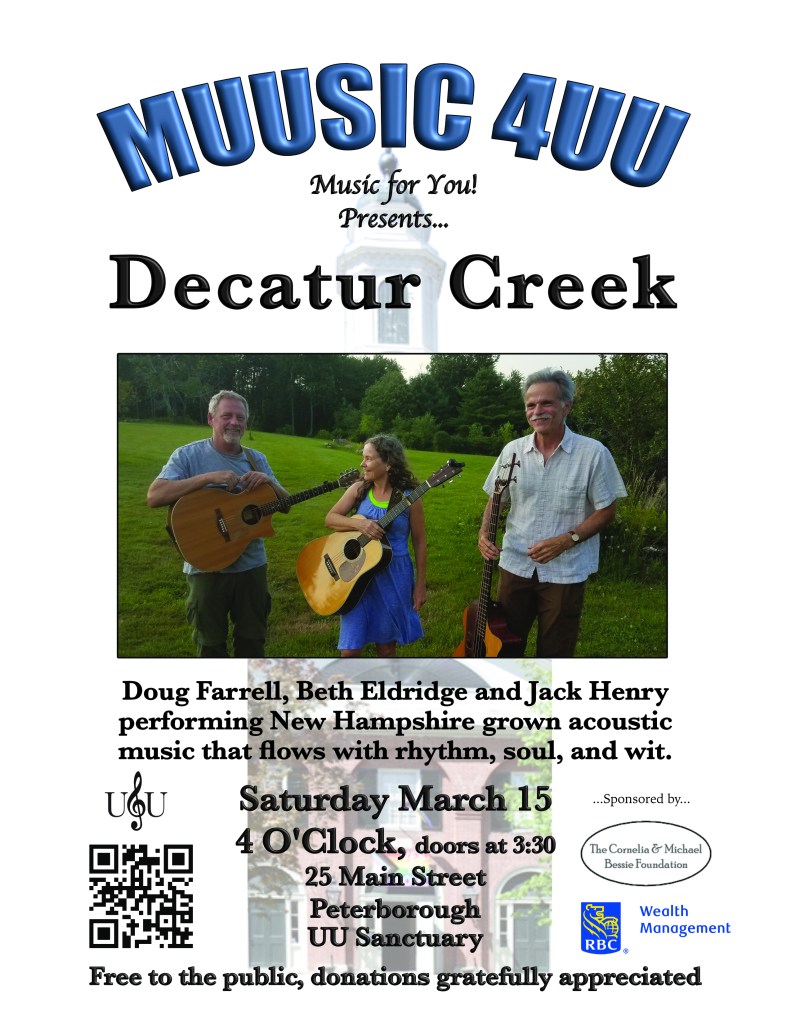
- March 15, 2025 Decatur Creek
- April 19, 2025 José Lezcano – Classical Guitarist, Grammy-nominated performer, Keene State College Faculty
- May 31, 2025 Peter Sykes – Hear our magnificent Organ played by this stellar performer!
- June 21, 2025 Tara Greenblatt
Converging Sources
The water flowing over the dam next to our house tells us that spring is underway. The source waters are Potato Creek on the northeast side of Stoddard Pond; once it crosses the spillway it becomes Beaman Brook. Spring is such a noisy time, especially coming out of the deep quiet of winter. No birds, no brook, waters frozen. Music is the best way to break up the silence, to bring some life back to us – music from many waters, many sources …
I log on to my YouTube channel and pause a moment by the source waters of Decatur Creek, sitting back and listening to the waters of New Hampshire. I hear a gently rocking fiddle floating on sweet melodies, sparkling jangles of guitar and mandolin penetrating through a constant undercurrent of harmonies and gentle voices murmuring, amplified over the water.
If there is a waterway named Decatur Creek someplace in New Hampshire or elsewhere, Google Maps is keeping that secret. I’ve heard through the grapevine that one of the band members had a creek of the same name running near his childhood home in upstate New York. Doug Farrell, Beth Eldridge and Jack Henry are the visionaries of Decatur Creek, and it is their unique and individual experiences that provide the bedrock.
So, the band is itself a confluence.
Doug Farrell, the band’s leader and singer/songwriter, has been on the scene for some time. Living in New Hampshire since the 90’s, he has been seen frequently in coffeehouses, festivals and on NHPR’s “The Folk Show.” While not writing or making music, he has a carpentry/cabinetmaking business and has also had some light shone on him more than once as a finalist and a winner in the New England Songwriting Competition. Some words off his website:
Doug’s songwriting is shaped by his artisan carpenter eye, the ear of a poet, and the heart of an artist. His songs, ranging from humorous to dark, are simple yet deceptively layered with nuance, wit, and substance that render them easy to hear and hard to forget.
Beth Eldridge is a Massachusetts native, hailing from Westborough and now living in about as central New Hampshire as you can get. Her musical training was “informal” by all accounts, playing guitar early on until she had the unparalleled opportunity to study fiddle with the great Alan Block, impresario of Celtic-influenced New England contra dance music in addition to Appalachian tunes. As an alumna of the now-defunct Bradford Bog People, her style of playing is solidly backwoods, pure and authentic. Good clogging music!
Jack H. Carleton grew up in Massachusetts, the child of a musical family, so the gigging lifestyle is not at all unfamiliar to him. However much he came to the “biz” as a natural, he took a more practical (and lucrative) route with a career in finance; after a gig-scouting trip to Nashville he discovered just how difficult it is to carve a path in music full time – our good fortune that we got him instead of Tennessee. His bass playing is so solid and resonant – the perfect foundation for music — perhaps we can continue the analogy and call it the aquafer.
Here is a little history on the Decatur Creek you see today (Jack speaking):
Doug and I had met in the early 2000’s at local coffeehouses and kept saying we should get together. But between work, family, school, etc. it just never quite happened. In 2011 I bought myself an acoustic bass for Christmas and showed up that spring at the Round Room coffeehouse in Mont Vernon and persuaded Doug to play for a bit. I didn’t know he had just partnered with another singer-songwriter (Steve Dionne) and had booked a gig, but got Steve to agree we 3 should get together and see. After about 20 minutes of playing together, Doug asked Steve “So, what do you think about Jack playing with us?” Steve replied, “I don’t want to play without him”! The feeling was mutual; we all quickly recognized the chemistry and Decatur Creek was formed. At Doug’s suggestion, Beth sat in and played with us on the side as the unique sole fitting addition. She continued to gig with her band The Bradford Bog People until they disbanded a few years later and she came on full-time with DC. Steve left the band in 2019 and the three of us have carried on since.
This blog has spoken previously about the rise of Americana – the genre of music which is itself a tangle of streams and tributaries. When I asked them individually about what musicians/groups had their greatest influence upon their playing, I received quite the range: Crosby, Stills, Nash and Young rose to the top of the list, but followed closely by other standard-bearers of Appalachian/Country music, including Merle Haggard, Gordon Lightfoot, Emmylou Harris, Willie Nelson, Waylon Jennings. But the singer-songwriter aspect is strong: Cat Stevens, Joni Mitchell, James Taylor, Bob Dylan. But coming from the other direction are greats among the rock genre: Allman Brothers, Little Feat, the Beatles and even Jimi Hendrix. And along the way kiddie pop group The Banana Splits are mentioned (Ok that was a youthful indiscretion. I confess to being in love with the Monkees.)
We’re clearly at a time when all our streams of music converge into the mighty river of American Music. As Jack Henry puts it, it’s all about “beautifully crafted songs, honest voices and playing that resonates.”
***
- March 15, 2025 Decatur Creek
- April 19, 2025 José Lezcano – Classical Guitarist, Grammy-nominated performer, Keene State College Faculty
- May 31, 2025 Peter Sykes – Hear our magnificent Organ played by this stellar performer!
- June 21, 2025 Tara Greenblatt

